.png)

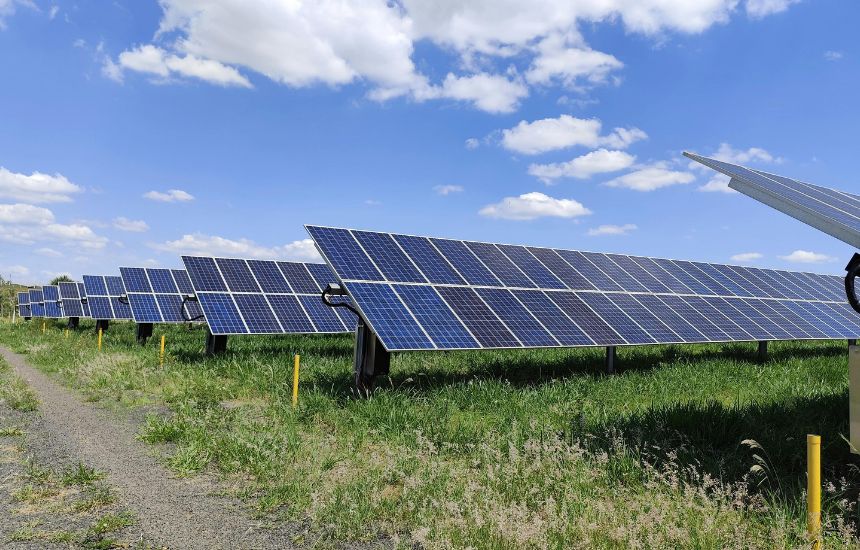
Solar Strong, Future Ready—India Powers Ahead of the World.
India has crossed one of its most significant clean-energy milestones, achieving 50% of its total installed electricity capacity from non-fossil fuel sources, a full five years ahead of the Paris Agreement deadline.
As of October 31, 2025, India’s non-fossil power capacity has reached 259 GW, with an impressive 31.2 GW added in the current financial year, according to the Ministry of New and Renewable Energy (MNRE). This achievement reinforces India’s position as one of the world’s fastest-growing clean-energy markets.
Responding to recent speculation, MNRE affirmed that it has not advised any lender to pause or restrict financing for renewable projects. Instead, the ministry shared detailed data on India’s expanding solar manufacturing ecosystem to help financial institutions adopt a calibrated, risk-aware funding approach.
This is particularly important as India rapidly develops upstream solar manufacturing, including
Government interventions—especially the Production Linked Incentive (PLI) Scheme for High-Efficiency Solar Modules—have catalyzed a massive expansion of domestic capacity. India’s approved manufacturing under ALMM has increased from 2.3 GW in 2014 to 122 GW in 2025, including backward integration.
This manufacturing surge strengthens supply chains, reduces import dependence, and positions India as a future global leader in solar module and component exports.
The government remains firmly aligned with its climate commitments, targeting 500 GW of non-fossil power capacity by 2030. The current progress puts India well ahead of schedule, enhancing:
India’s rapid progress underscores a clear message:
A stronger, greener, self-reliant energy future is no longer a vision—it is unfolding now.
.png)
.png)
.png)
.png)
-preview.webp)
-preview.webp)
-preview.webp)
-preview.webp)
-preview.webp)